
Chapter Two: The Ring That Wasn’t Lost
The House Between Tides:
Year One: What the Tide Returned
The tide returns every Friday. A new chapter of the House Between Tides arrives each week.

Clara knew better than to put on a ring that had crossed thirty feet of dry floor on a tide no one else could see. She picked it up anyway. The silver was so cold it burned. Water ran from the blue thread and slipped between her fingers, but not one drop struck the floor. Clara watched it disappear against her skin. For an instant, the hallway vanished. Women were speaking somewhere beyond a wall.
Not singing. Counting. Thirteen. Twelve. Eleven. Their voices overlapped like water moving over stones. Beneath them, a child whispered something Clara could not understand.
Then came her mother's voice, young and terrified.
“That is not what I asked you to take.”
Clara dropped the ring. The hallway returned. The silver band landed without a sound and spun in the shallow light. Once. Twice. Three times. It settled against the baseboard with the blue thread curled around it like a question mark. Clara pressed her back to the wall. The red door stood six feet away. Nothing moved beneath it now. No water. No shadow. No sign that the sea had entered a house sitting hundreds of yards from the ocean.
Her phone rang in the kitchen. Clara flinched so hard that her shoulder struck the wall. The ringing stopped. It began again before she reached the table. RUTH flashed across the screen.
Clara answered without speaking.
“Did you touch it?” her mother asked.
The question cleared the last of Clara's fear and left anger in its place.
“How do you know there is something here?”
“Did you touch it?”
“You mean the ring you told me you lost?”
Ruth inhaled slowly.
“Listen to me. Do not put it on.”
“Why?”
“Because it was not given to you.”
“It was left at my feet.”
“That does not mean it was given.”
Clara looked toward the hall. From the kitchen, she could see only the edge of the silver band.
“Whose ring is it?”
Her mother did not answer.
“I remember you wearing it.”
“You remember many things incorrectly.”
“No. You trained me to distrust the things I remember.”
The words surprised them both. Ruth's breathing changed. Clara heard a small click, then the scrape of a chair. Her mother had sat down.
“Some memories are doors,” Ruth said. “Once opened, they do not care whether you were ready.”
“Miriam told me not to use the red door.”
“For once in your life, do exactly as you were told.”
Clara almost laughed. It was such a perfectly Ruth sentence. Obedience disguised as concern.
“What happened here in 1971?”
The silence stretched so long that Clara could hear gulls crying beyond the marsh.
“Your aunt liked ceremonies,” Ruth said at last. “She liked making ordinary grief feel important.”
“There is a photograph of thirteen women.”
“Burn it.”
“You are in it.”
“Then you should understand why I want it burned.”
Clara gripped the phone. “Who is the child by the water?” Ruth made a sound so small it might have been the beginning of a name. Then she recovered.
“Take the ring to the ocean before sunset,” she said. “Walk into the water until it reaches your knees. Throw the ring past the breaking waves and do not watch where it lands.”
“Was it yours?”
“No.”
“Did you wear it?”
“Yes.”
“Did you lose it?”
Ruth's answer came quietly.
“I paid with it.”
The call ended. Clara stared at the dark screen. Outside, something scraped across the back porch. She turned. An older woman stood beyond the kitchen door holding a paper grocery bag and a red metal thermos. Her gray hair was cut bluntly at her jaw. She wore rubber boots, a navy raincoat, and the expression of someone who had already waited as long as she intended to.
Clara opened the door but kept one hand on the frame. The woman glanced at it and nodded once.
“You must be Clara.”
“Who are you?”
“Etta Pike. I live past the marsh bend, in the white house that looks like it ought to have fallen down but hasn't.”
Clara waited. Etta lifted the grocery bag slightly. “Miriam asked me to bring supper if you came.”
“She knew I would come today?”
“No. She knew you would arrive hungry.”
Etta made no move toward the open doorway. Clara realized she was waiting to be invited. The house had admitted Clara only after she announced herself. It seemed suddenly reckless to offer another person entry merely because she carried soup.
“How well did you know my aunt?” Clara asked.
“Well enough to miss her. Well enough to be angry with her. Those are usually the same measure.”
It was the first honest description of Miriam anyone had given Clara.
“Did you know my mother?”
Etta's mouth tightened.
“Yes.”
“Were you here in 1971?”
“No.”
The answer came too quickly, but it came cleanly. Clara could not decide which mattered more.
“You may come in,” she said. “Through this door.”
Etta stepped over the threshold. The copper bell rang above her. She stopped.
“It likes you,” Clara said.
“No, it doesn't.” Etta removed her boots. “It recognizes me. That is not the same thing.”
She carried the bag to the table and began unpacking containers of soup, bread wrapped in waxed paper, two apples, and a small jar of honey.
“Have you opened the red door?” she asked.
“No.”
“Good.”
“Why?”
“Because Miriam told you not to.”
“I am tired of that answer.”
“Then you are ready for a better question.”
Etta unscrewed the thermos and poured coffee into its metal cap. She drank it standing up. Clara folded her arms. “What question?”
“Not why the door must stay closed. Ask what the door is for.”
“Doors are for entering and leaving.”
“Most are.”
Etta walked into the hall. When she saw the ring, she stopped so abruptly that coffee spilled over her knuckles. She did not appear surprised. She appeared offended.
“It has no right,” she said.
“The ring?”
“The tide.”
Etta set down the coffee. She crouched several feet from the ring but did not touch it.
“What did you hear?”
Clara's stomach tightened. “How do you know I heard anything?”
“Because you picked it up, and Miriam is no longer here to stop you.”
“Women counting backward. A child. My mother saying it took the wrong thing.”
Etta studied Clara's face.
“Your mother told me to throw it into the ocean.”
“Of course she did.”
“She said she paid with it.”
At that, Etta looked toward the red door.
“Did she?” Clara asked.
“That depends on who you believe accepted the payment.”
“I don't believe any of this.”
Etta stood. “Belief is cheap. Pay attention instead.” She returned to the sitting room and took the photograph from the mantel. Clara watched her examine the fourteen figures, the date, and the sentence written on the back. For the first time, Etta's composure broke. Her thumb moved across the blurred child at the water's edge.
“Who is she?” Clara asked.
“A question is not an answer merely because you ask it loudly.”
“You knew Miriam. You knew my mother. You know about the door, the ring, and whatever happened here. Do not stand in my aunt's house and tell me to be patient.”
Etta replaced the photograph on the mantel with deliberate care.
“Fair enough.”
She pulled out a chair and sat at the table.
“Get paper.”
“Why?”
“Because fear makes poor records.”
Clara found a yellow legal pad in a desk drawer. Etta drew three columns and labeled them Observed, Told, and Assumed.
“Write what happened with the ring,” she said.
Clara remained standing.
“I don't need a thinking exercise.”
“You need one more than you need a ghost story.”
Clara sat. Under Observed, she wrote: Water entered beneath the red door although the porch was dry. A silver ring remained after the water withdrew. The ring was tied with blue thread.
When I touched it, I heard voices. Under Told, she wrote: Ruth wore the ring. Ruth said it was not hers. Ruth said she paid with it.
Miriam said not to use the red door. Under Assumed, she began to write The sea returned the ring, then stopped.
“I saw the water,” Clara said.
“You saw water.”
“It smelled like the ocean.”
“Then write that under observed.”
“You just said the tide had no right.”
“Which belongs under told. You were told, by me, that I believe the tide returned it. My belief is not your observation.”
Clara looked at Etta with new interest.
“You are surprisingly careful for someone discussing impossible water.”
“The stranger the event, the more exact the witness must become.”
Etta tapped the empty space under Assumed.
“That column is where most people build the thing that frightens them.”
Clara wrote: The ring was meant for me. The voices belonged to the women in the photograph. The child I heard was the child by the water. My mother is trying to protect herself rather than me.
The last sentence was the hardest. Etta read it but did not comment.
“Now,” she said, “you have somewhere to begin.”
“Begin what?”
“Finding out which column has been running your life.”
The room darkened as clouds moved over the sun. On the mantel, the thirteen women disappeared into the glass of the photograph. The child's pale shape remained visible. Clara set down the pen.
“Tell me one true thing about 1971.”
Etta considered this.
“Your mother went into the water wearing that ring.”
“Why?”
“You asked for one true thing.”
“Tell me another.”
“She did not come out alone.”
Clara felt the skin tighten across her arms.
“The child?”
Etta stood and began fastening her raincoat.
“That belongs under assumed.”
“You cannot leave after saying that.”
“I can. Miriam left me instructions too.”
“What instructions?”
“Feed you. Make sure you had not opened the red door. Tell you how to keep a clean record. Leave before dark.”
Clara looked through the kitchen window. The sky had deepened from gray to blue-black. Across the marsh, the tide moved between the grass in bright veins.
“What happens after dark?”
“Tonight? Probably nothing.”
“Probably?”
“Miriam said certainty is just fear wearing a pressed shirt.”
Despite herself, Clara smiled. Etta slipped on her boots at the back door.
“The black bowl on the hearth should remain filled with salt. The windows should be latched before the tide turns. Do not sweep after sunset. Do not answer a voice merely because it knows your name.”
“Those sound like rules.”
“They are habits. Rules invite people to test them.”
“And the ring?”
Etta looked toward the hall.
“Do not return something until you understand why it came back.”
“My mother said it must go into the ocean before sunset.”
“Your mother has spent fifty-five years trying to finish one night by repeating it.”
The copper bell rang as Etta stepped onto the porch.
“Wait,” Clara said. “The king tide. Miriam told me to come before it. When is it?”
Etta glanced toward the marsh.
“Tomorrow night.”
“What will happen?”
“The water will rise.”
“That isn't what I meant.”
“It is the only part I know.”
Etta walked down the porch steps and disappeared around the eastern side of the house. Clara locked the door behind her. She ate the soup standing at the kitchen counter. It tasted of tomatoes, smoked pepper, and something green she could not name. She carried the black bowl to the pantry and found a paper sack of coarse salt on the bottom shelf. On the inside of the pantry door, hidden when it stood open, Miriam had written five lines directly onto the wood.
Welcome those you choose.
Name what you witness.
Keep the hearth.
Return nothing in anger.
The red door is not an entrance.
Below the final line, in smaller writing, were the words:
It is a mouth.
Clara read the sentence twice. Then she closed the pantry door. She filled the black bowl and returned it to the hearth. She latched the six windows. The light switches worked, but every bulb produced the same dim amber glow, as if the house preferred evening and intended to keep it. The ring remained in the hall. Clara found a pair of iron fireplace tongs and used them to lift it by the blue thread. She carried it into the sitting room and lowered it into an empty glass jar.
The instant the ring touched the bottom, the grandfather clock began to strike. Clara counted eleven chimes. Her phone said 6:42. The clock had no hands.
“Observed,” Clara whispered.
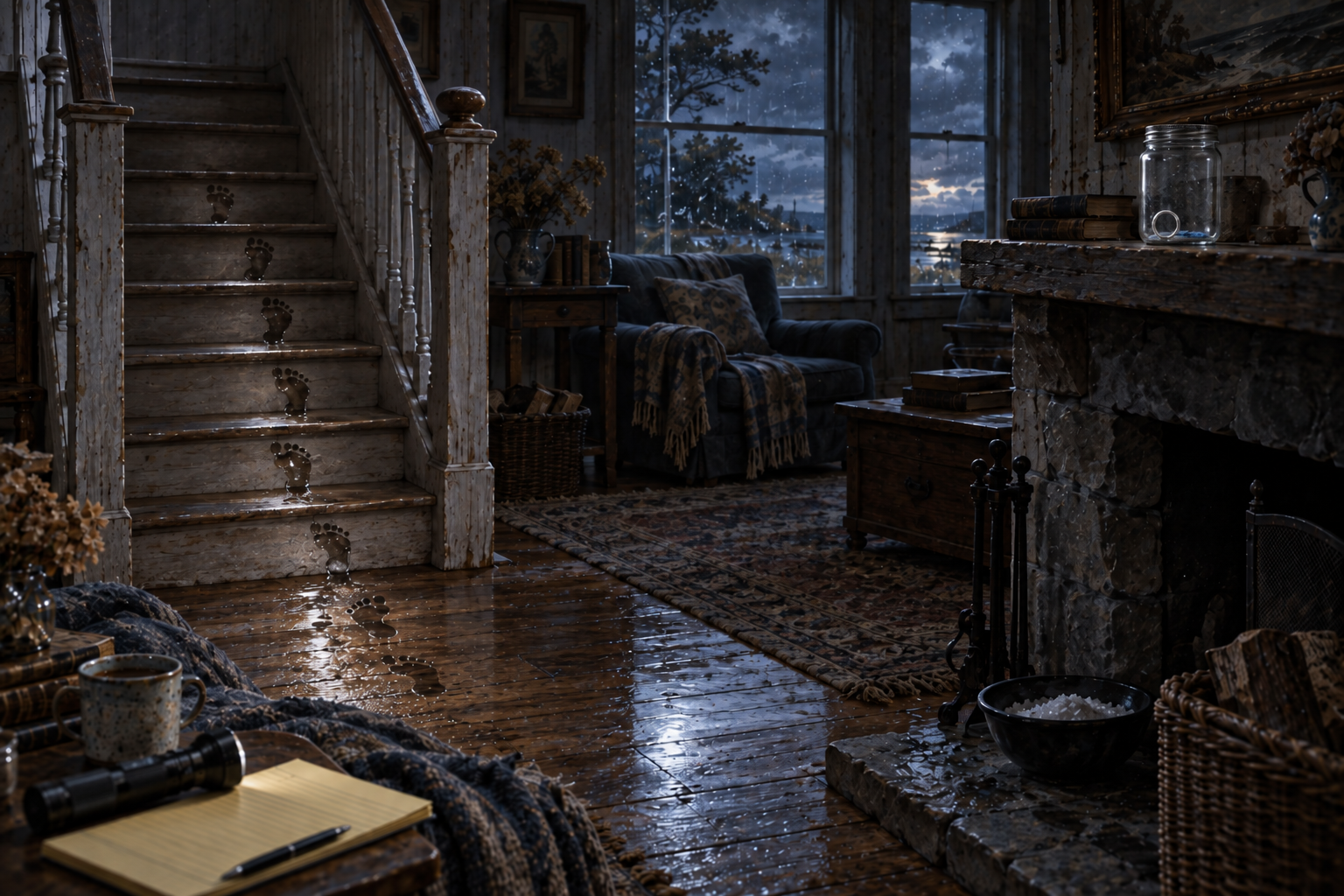
She wrote it on the legal pad. The discipline helped. Facts were edges. She could hold them without cutting herself on meanings she had not chosen. By nine, rain had begun. By ten, wind pressed wet leaves against the windows. Clara took a quilt from the linen cupboard and made a place for herself on the sitting room sofa. She kept the lamp burning and the jar on the mantel where she could see it. She tried calling her mother twice. Ruth did not answer. At 11:13, Clara wrote one more item beneath Observed:
The ring has turned upright inside the jar. She was certain she had placed it flat. At 11:40, she added: The blue thread is no longer wet. At 12:06:
There are footsteps upstairs. Clara set down the pen. The house held its breath. A floorboard creaked above her. Then another.
The steps were light and evenly spaced. They crossed the room overhead, paused, then moved toward the staircase. Clara stood. Every part of her wanted to run for the back door, but the storm had swallowed the yard and her car sat beneath the live oaks. The first stair groaned. Then the second. Clara took the flashlight from her bag and gripped it with both hands.
The third stair creaked.
“Who is there?”
The footsteps stopped. Etta's warning returned to her. Do not answer a voice merely because it knows your name. A child spoke from the dark staircase.
“Clara?”
Clara did not answer.
“Clara Voss?”
The voice was young, but there was something exhausted beneath it. Something that had been calling for a very long time. Clara raised the flashlight and switched it on. The staircase was empty. Wet footprints marked the wooden steps. Small bare feet.
They began halfway down. Clara moved the light upward. No prints came from the landing. None crossed the upper hall. The trail simply began on the seventh stair and descended toward her. One by one, new footprints appeared. Sixth stair. Fifth.
Fourth. Nothing stood above them. Clara backed toward the hearth. The invisible feet reached the final stair. The ring struck the inside of the glass jar.
Once. Twice. Three times. The wet footprints stopped at the edge of the sitting room. The child's voice came again, now close enough for Clara to hear the water caught in her breath.
“Is Ruth home?”
Clara looked at the legal pad. Observed. Told. Assumed. She forced herself to speak carefully.
“I am not Ruth.”
Every lamp in the house went dark. From inside the jar, a little girl began to laugh.
From the Keeper's Book: Discernment Before Meaning
Not every unusual experience must be dismissed, and not every unusual experience should immediately be treated as a message. Discernment begins by separating what happened from the meaning we placed upon it. When something feels significant, divide a page into three sections:
Observed: What did you directly see, hear, feel, or verify?
Told: What information came from another person, a book, a tradition, or an interpretation?
Assumed: What conclusion did you add to the experience?
Then ask one more question:
What else could be true?
This does not weaken intuition. It protects intuition from fear, wishful thinking, and other people's certainty. Clara does not deny what is happening inside the house. She also refuses to let the first explanation become the only explanation. Before she can understand what the tide returned, she must learn to witness without surrendering her judgment.
