
Chapter One: The Key in the Black Envelope
The House Between Tides:
Year One: What the Tide Returned
The tide returns every Friday. A new chapter of the House Between Tides arrives each week.
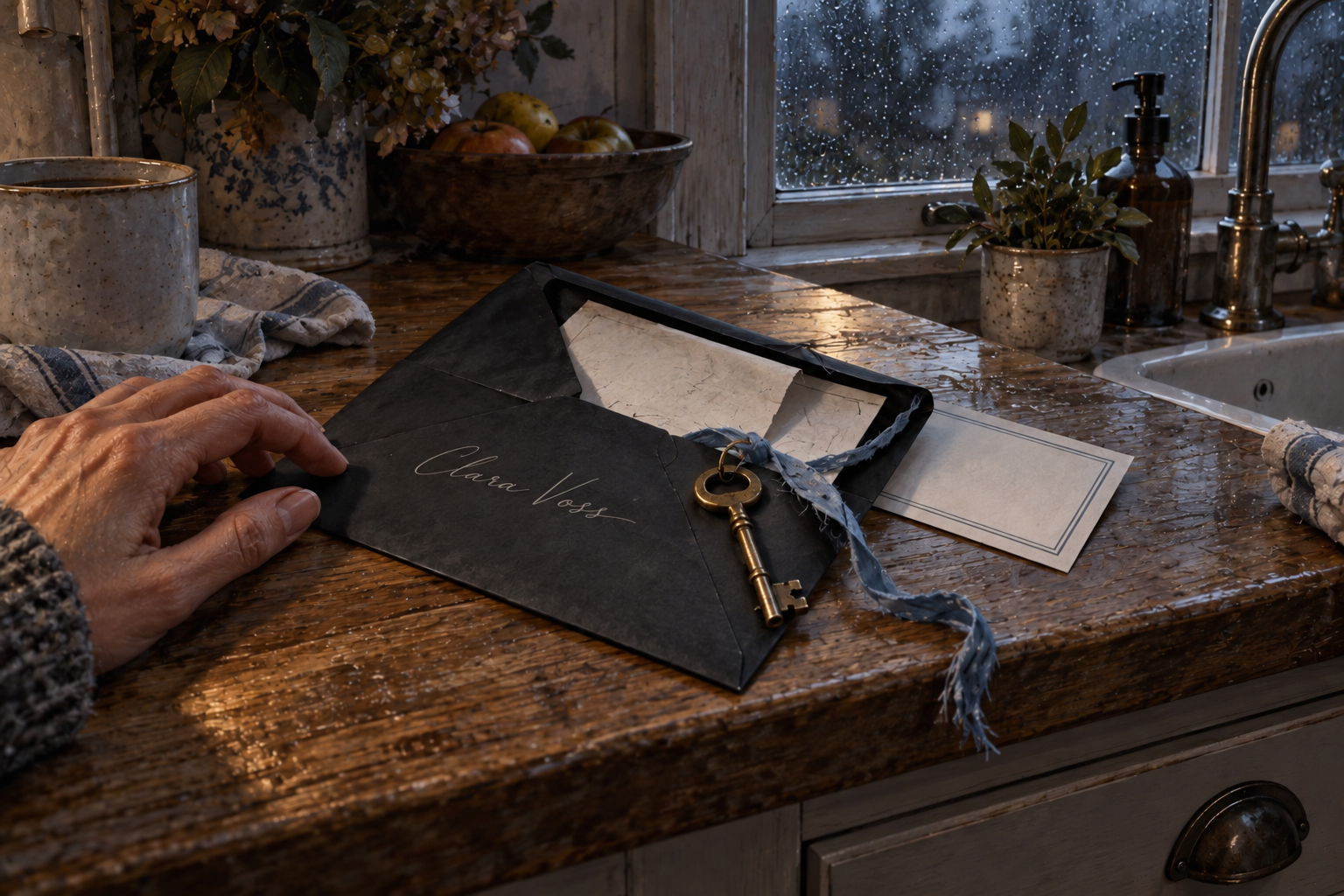
The key arrived three days after they buried a woman Clara Voss had believed was dead for thirty-one years. It came in a black envelope with no stamp, no return address, and her name written across the front in silver ink. Not printed. Written. The letters leaned toward one another as if sharing a secret. Clara found it on the floor beneath the mail slot when she came home from work. She nearly stepped on it. For several seconds she simply stared.
Nobody wrote to her by hand anymore. Her daughter sent photographs. Her mother sent clipped articles about blood pressure and identity theft. The man Clara had almost divorced twice preferred messages consisting of a single question mark. The envelope felt heavier than paper should. She carried it to the kitchen and placed it beside the sink. Rain tapped the windows, soft and impatient. October had spent the whole week threatening a storm but refusing to commit to one.
Clara opened the drawer where she kept scissors, batteries, birthday candles, and the other small things that had no true home. Before she could choose a blade, the envelope opened beneath her fingers. Not tore. Opened. The flap had never been sealed. Inside was a brass key tied to a length of faded blue thread. Beneath it lay a folded piece of paper and a card from a law office in Morrow Point, North Carolina. She read the card first.
Ms. Voss, our office has attempted to reach you regarding the estate of Miriam Voss. Please telephone us at your earliest convenience.
Clara read it again. Then a third time. The room altered around her without anything moving. The refrigerator continued its low hum. The clock above the stove advanced from 6:12 to 6:13. Rain continued tapping the glass. Yet the kitchen no longer felt like the same kitchen in which she had stood a moment before. Miriam Voss was her mother's older sister. Miriam Voss had died when Clara was twenty.
Clara remembered because she had been in her college laundry room when her mother called. The dryers had been turning behind her, making the metal chairs tremble against the wall.
“Your aunt Miriam is gone,” her mother had said.
Not dead. Gone. Clara had cried into a pillow that smelled of detergent and somebody else's dryer sheets. There had been no funeral she was allowed to attend. No obituary. No photograph chosen for a mantel. Her mother said Miriam had wanted it that way. For thirty-one years, Clara had believed her. She unfolded the letter. The paper smelled faintly of cedar and salt.
Clara,
If this has reached you, then Ruth has outlived her lie. Do not hate her for it yet. A lie kept long enough begins to believe it is protecting someone.
The house is yours, if you are willing to enter it. Come before the king tide. Come alone. Bring nothing you are afraid to lose.
Do not use the red door.
Miriam
Clara stood with the letter in one hand and the key in the other until the metal grew warm against her palm. Then she called her mother. Ruth answered on the fourth ring.
“What is it?”
No hello. There was never a hello when Ruth suspected that the world had finally come to collect something.
“Aunt Miriam died.”
Silence. Clara heard the hollow television voices in the background go quiet. Her mother had muted them.
“Who told you?”
“A lawyer.”
“What lawyer?”
“One in Morrow Point.”
Another silence followed, but this one was different. It had weight. Clara could feel her mother measuring every possible answer and finding each one dangerous.
“She left me the house,” Clara said.
Her mother drew a sharp breath. That was when Clara knew the letter was true.
“You will decline it,” Ruth said.
“You told me she was dead.”
“I told you she was gone.”
“You knew what I thought that meant.”
“It meant she was gone from us.”
Clara closed her eyes. At fifty-one, she should have been immune to her mother's talent for turning guilt into grammar. She was not.
“Why?”
“Because some doors should stay closed.”
Clara looked down at the key.
“She said not to use the red one.”
The phone went so quiet that Clara checked the screen to see whether the call had ended. Then Ruth spoke, very softly.
“Throw away the key.”
“What happened in that house?”
“Nothing happened in the house. The house is what happened.”
The line disconnected. Clara did not sleep. At 2:17 in the morning she searched Miriam's name and found an obituary with a photograph taken on a porch. Miriam was eighty-three when she died. Her hair had gone white, but Clara recognized the sharp cheekbones, the unsmiling mouth, and the dark eyes that always seemed to notice the thing a person hoped to hide. The obituary was six sentences long. Miriam had lived alone. She had kept a coastal garden. She had repaired fishing nets for three generations of local families. She was survived by no one.
Clara read that last sentence until anger replaced disbelief. She remembered Miriam kneeling beside her on the same porch when Clara was seven. A summer storm had turned the sky green. Wind bent the marsh grass almost flat, and Ruth had been inside shouting that they needed to leave. Miriam had placed one hand on the porch post and told Clara to do the same.
“A threshold is not only a doorway,” she had said. “It is the place where one thing decides whether it will become another.”
Clara had not understood.
“Is the storm a threshold?” she had asked.
Miriam smiled. “For something.” By eight the next morning, Clara had packed a change of clothes, a flashlight, two bottles of water, and the letter. She left the television, the laptop, and the framed wedding photograph where they were. She removed her ring in the driveway and placed it inside the glove compartment. Bring nothing you are afraid to lose. She told herself the instruction was practical. The house might be unsafe. The area might flood. An eighty-three-year-old recluse might have left behind bad wiring, rotten floors, and thirty years of newspapers. She did not tell herself why she had obeyed.
Morrow Point sat where the mainland thinned into marsh and the roads began behaving like suggestions. Clara had not been there since childhood. Developers had discovered the outer edges, filling them with pale houses on stilts, but the old town remained low and weathered. Live oaks leaned over the streets. Ditches shone with rainwater. Hand-painted signs advertised shrimp, boat repair, bait, and rooms by the week.
The closer Clara came to the coast, the less reliable her phone became. The blue route line disappeared first. Then the map turned into a blank square with her location pulsing in the middle like a lost heartbeat. She remembered the way without understanding how. Left at the abandoned church. Right where the road divided around an oak tree. Straight until the pavement became crushed shell. The house was beyond the last mailbox, past a rusted cattle gate that stood open. The marsh appeared all at once.
Silver water threaded between islands of cordgrass. White birds lifted from the shallows as Clara's car approached. Beyond the marsh lay a narrow rise of land, then the ocean, hidden but loud. The house stood between them. It was taller than Clara remembered, narrow and gray, with two chimneys and a roof pitched steeply against storms. Salt had stripped most of the paint from the cedar shingles. The windows reflected the afternoon sky so perfectly that the house seemed blind. A red door faced the road. Its color was not faded. It was the deep red of wet clay, rowan berries, and blood seen through water.
Clara stopped the car twenty feet from the porch. For the first time since leaving home, she considered turning around. The thought brought an unexpected wave of exhaustion. It was the same exhaustion she had felt each time she postponed speaking plainly to her husband. The same exhaustion that followed every conversation in which her mother revised the past while Clara stood by and allowed it. She recognized it now as the price of retreating from her own knowing. She switched off the engine. The ocean filled the silence.
On the porch, the red door waited beneath a horseshoe nailed with its opening facing down. Clara remembered hearing that a horseshoe should face upward to hold luck. Miriam had laughed when someone said it.
“Luck turns stagnant when you hoard it,” she had replied.
Clara climbed the steps but did not touch the door. The brass key pulled slightly against her hand. She almost dropped it.
“No,” she whispered. “Keys do not pull.”
Somewhere under the porch, something knocked once. Clara stepped backward. Nothing followed. She walked around the eastern side of the house. Wax myrtle crowded the walls, glossy and fragrant after rain. Three iron nails had been driven into the ground beside the foundation, each tied with blue thread like the thread around the key. At the back of the house she found a smaller porch overlooking the marsh. Its steps were slick with moss. A plain wooden door stood beneath a copper bell green with age.
The key entered the lock smoothly. Clara turned it. Nothing happened. She tried again, pushing her shoulder against the door. The lock moved, but the door remained fixed.
“Swollen wood,” she said aloud.
The bell above her stirred, though the air was still. She pushed harder. The house resisted. Clara closed her fingers around the key and felt anger rise through her. Miriam had lied by omission. Ruth had lied deliberately. A lawyer had sent her across two counties with a key and no explanation. Now an old house had the nerve to refuse her entry. She drew back to kick the bottom panel.
Then she remembered Miriam's hand resting against the porch post. A threshold is the place where one thing decides whether it will become another. Clara lowered her foot. She placed her palm flat against the door. The wood was warm.
“My name is Clara Voss,” she said, feeling foolish. “Miriam asked me to come.”
She hesitated. The woman who had arrived at the house wanted proof. The woman standing at its threshold wanted the truth. Clara suspected she could not take both inside.
“I am here by my own will,” she said.
The door opened beneath her hand. The kitchen smelled of cedar, dried rosemary, and a fire extinguished hours ago. Clara remained on the porch. Every house has a silence, but this one had several. The silence of abandonment was not among them. A blue cup stood upside down on a towel beside the sink. Bundles of herbs hung from a beam, their leaves darkened with age. A pair of mud-stained boots waited beside the back door. In the center of the room sat a long wooden table marked by knife cuts, candle wax, and pale rings left by hundreds of cups.
One place had been set. A white plate. A folded napkin. A water glass turned upright. Beside the plate lay a card bearing Clara's name. She should have left then. Instead, she crossed the threshold.
The copper bell rang once behind her. Clara spun around. The door remained open. No wind moved through the kitchen. The hanging herbs were still. She picked up the card.
You remembered to announce yourself. Good. The house dislikes being treated as an empty thing.
Clara turned it over.
Before you begin, open the curtains. A secret grows teeth in the dark.
There were six windows in the kitchen and adjoining room. Clara opened each curtain, releasing small clouds of dust. Gray light entered cautiously. The house revealed itself by degrees. Books filled the walls of the sitting room, but not in any order Clara understood. Field guides stood beside ledgers. Collections of coastal folklore leaned against tide charts, cookbooks, anatomy texts, and hand-bound volumes without titles. Shells lined the mantel. A black bowl filled with salt sat on the hearth. Over the fireplace hung a portrait of thirteen women standing outside the house. Clara recognized Miriam immediately.
She was young in the photograph, perhaps thirty. Her dark hair fell loose to her waist. Twelve other women stood beside her, some smiling, some solemn, all touching one another at the shoulder or hand. Ruth stood at the far left. Clara moved closer. Her mother could not have been more than twenty. She wore a pale dress and held a bundle of white flowers against her chest. On the back of her left hand was a dark crescent-shaped mark Clara had never seen. The photograph was dated October 1971.
Beneath the date someone had written:
The night Ruth crossed.
Clara took the frame down. The paper backing had loosened with age. When she touched it, a smaller photograph slipped out and landed facedown on the floor. It showed the same thirteen women standing in the same order. Only this time, they were facing the ocean. A fourteenth figure stood at the water's edge.
The image had blurred around her, but Clara could see that the figure was a child. A girl in a dark dress with one hand raised toward the women. Clara turned the photograph over. There was no date. Only one sentence.
We gave back the wrong daughter.
The front door rattled. Clara froze. Three knocks sounded through the house. Not from beneath the porch this time. Someone was standing outside the red door.
Clara placed the photograph on the mantel and moved into the hall. The old floorboards creaked under her feet. At the far end, the red door shuddered in its frame. Three more knocks came.
“Who is it?” Clara called.
No one answered. She looked through the narrow window beside the door. The porch was empty. Beyond it, the road, the marsh, and her car sat under a bruised October sky. Nothing moved except the tall grass bending toward the sea. Clara looked down.
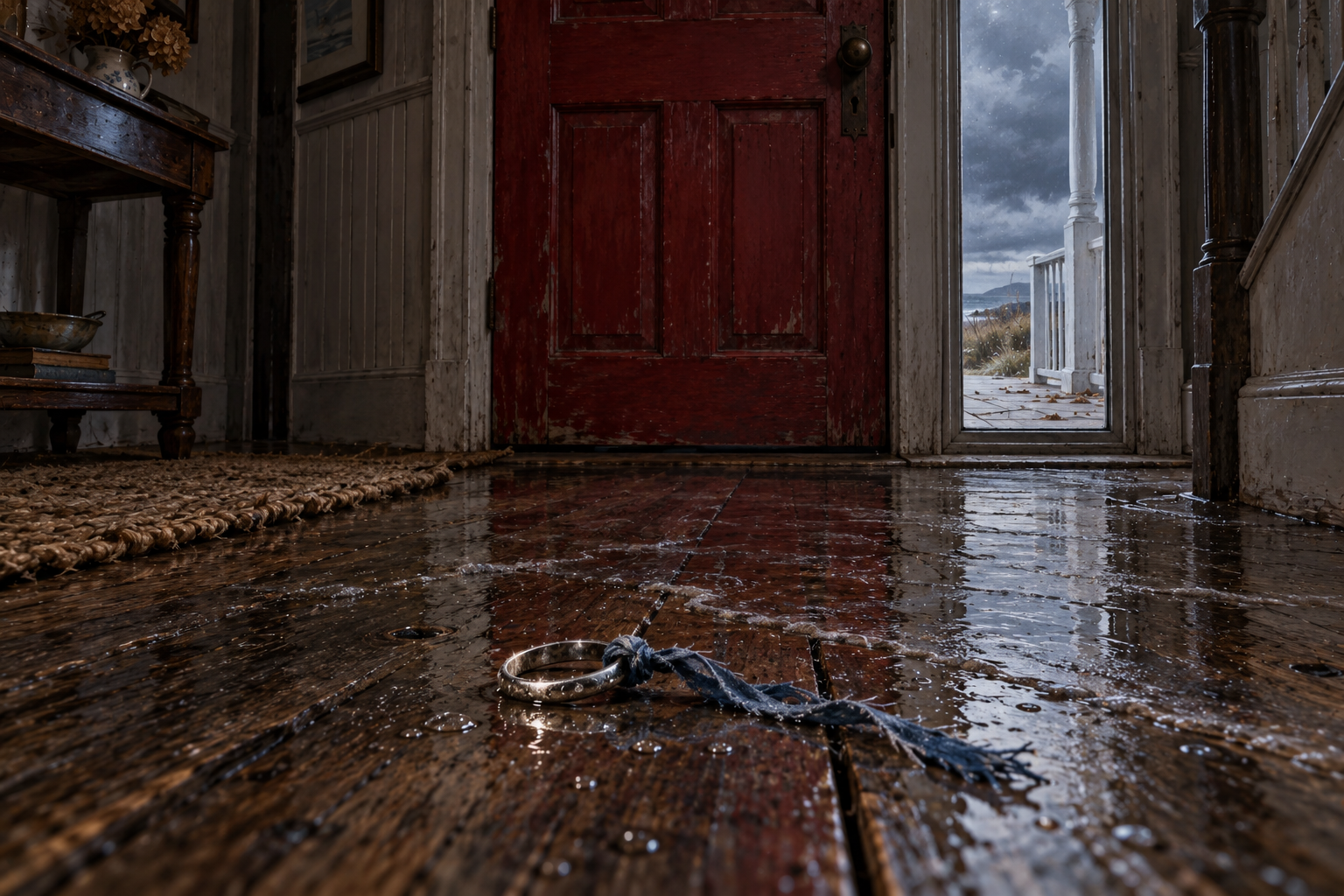
Water crept beneath the red door. It formed a shining line across the floorboards, though the porch outside was dry. The line widened. A smell of salt and deep water filled the hall. Something struck the other side of the door with a soft, heavy thud. Clara remembered Miriam's warning. Do not use the red door.
She did not reach for the knob. Instead, she stepped back. The water stopped at the toes of her shoes. For one suspended moment, the entire house seemed to listen. Then the tide withdrew beneath the door, leaving a single object on the floor.
A strand of blue thread. It was wet, freshly cut, and tied around a small silver ring. Clara knew the ring. She had seen it every day of her childhood on her mother's right hand. Ruth had told her it was lost in 1971.
The year she crossed.
From the Keeper's Book: The First Threshold
A threshold is more than the wood or stone beneath a doorway. It marks the place where one condition ends and another begins. The moment before a decision, the first night in a new home, the ending of a relationship, the beginning of a practice, and the instant we finally admit what we know can all become thresholds. Crossing deliberately changes the experience. It asks us to notice what we are leaving, what we are choosing, and what we are attempting to carry into the next place.
Before crossing an important doorway, pause with one hand against the frame. Feel your feet beneath you. Name what you are leaving outside, even if you speak only in your mind. Then say:
I enter by my own will. I carry only what belongs with me. What does not honor me may not follow.
Step across without rushing. The purpose is not to fear every doorway. It is to stop moving unconsciously through the moments that change us. Clara's first act of magic was not opening the house. It was recognizing that she had the right to decide how she entered.
