
Chapter Three: The Wood Written on Wood
The House Between Tides:
Year One: What the Tide Returned
The tide returns every Friday. A new chapter of the House Between Tides arrives each week.
The little girl laughed from inside the jar, and Clara understood why frightened people made terrible bargains.
In that moment, she would have promised almost anything to make the sound stop.
The room was completely dark except for the weak circle cast by her flashlight. It caught the edge of the mantel, the black bowl of salt, and the jar where the silver ring stood upright against the glass. Nothing moved inside it. There was only the ring, the faded blue thread, and Clara's own reflection stretched thin across the curve.
The laughter came again.
It was not loud. That made it worse. It held the private delight of a child hiding beneath a table while adults searched the wrong room.
Clara aimed the flashlight at the staircase. Wet footprints still marked the steps, but no new ones appeared. The final pair rested on the floor at the entrance to the sitting room.
They had not crossed.
Clara looked toward the kitchen. The pantry door stood open, hiding the words Miriam had written on the inside. She could see only the bottom line.
It is a mouth.
Her first impulse was to throw salt at the jar. Her second was to seize the fireplace poker and smash it. Both thoughts arrived hot and certain, which made her trust neither.
She forced herself to look at the legal pad.
Observed.
Told.
Assumed.
“I hear laughter,” Clara said.
The sound stopped.
She waited, then wrote the sentence beneath Observed. Her hand shook badly enough that the letters climbed uphill.
“I see wet footprints. They have not entered the sitting room.”
She wrote that too.
The ring struck the jar once.
Clara did not answer it.
She carried the black bowl to the hearth and discovered that the salt beneath the surface had gone damp. The room smelled of wet stone and old smoke. Keep the hearth, Miriam had written. Clara had thought it meant keeping the bowl filled or honoring some symbolic center of the house. At that moment, it occurred to her that it might mean exactly what it said.
The fire had gone out.
A copper box beside the grate held kindling, pine shavings, and three books of matches. Clara knelt, arranged the driest pieces beneath two split logs, and struck a match. The first went dark before she touched it to the shavings. The second burned blue and cold. The third caught.
Flame moved through the pine in a quick golden line. The logs smoked, settled, and began to burn. Heat touched Clara's face.
Behind her, the jar clicked softly.
She did not turn around.
“I did not invite you into this room,” she said. “You may be heard from where you are. You may not come closer.”
The words sounded formal, but they were the truest ones she had.
For several seconds, nothing happened. Then the wet footprints began to fade from the floor upward. The last pair disappeared first. The prints on the bottom stair vanished next, followed by the ones above them, until only two small marks remained on the seventh step.
Those did not fade.
Clara fed another log to the fire and sat on the rug with her back against the sofa. She kept the legal pad in her lap. The house gave small night sounds around her. Rain tapped the western windows. Pipes shifted in the walls. Once, something scraped along the outside of the house from the kitchen toward the road.
Clara wrote down the time.
2:43 a.m.
She did not investigate.
At some point before dawn, exhaustion dragged her into a shallow sleep. She dreamed of standing in a hallway while women argued behind a closed door. She could not hear what they were saying, but she knew they were deciding which person would be allowed to come home.
When she woke, gray light filled the room. The fire had collapsed into red coals. The jar sat exactly where she had left it. The ring lay flat at the bottom again.
The two footprints remained on the seventh stair.
Someone knocked at the back door.
Clara sat upright, every muscle protesting.
Three knocks. A pause. Then two.
She looked through the kitchen window before opening it. Etta Pike stood on the porch holding a canvas tool bag and two lidded cups.
Clara opened the door.
Etta raised one cup. “Coffee.”
Clara stepped aside. “You may come in.”
The copper bell rang once as Etta crossed. She looked at Clara, then at the blanket on the floor, the legal pad, and the fireplace poker lying within reach of the sofa.
“The house chew on you?”
“A child laughed from inside a jar.”
“That is not an answer to my question.”
“Then yes.”
Etta handed her the coffee and walked into the sitting room. She did not approach the jar. Instead, she examined the staircase.
“There were footprints all the way down,” Clara said. “They stopped at the room. I told whoever made them that they could not come closer.”
“And?”
“They disappeared except for those two.”
Etta looked at the seventh stair.
“What does that mean?” Clara asked.
“It means two wet marks remain on a step.”
“You are enjoying this.”
“A little.”
Clara drank the coffee. It was strong, hot, and more reassuring than any explanation Etta might have offered.
“I also heard something scrape along the western side of the house at 2:43.”
Etta's amusement disappeared.
“Show me.”
They went first to the pantry. Clara opened the door and pointed to Miriam's writing.
“I found these last night.”
Etta read the five lines without expression.
“You knew they were here.”
“I knew Miriam kept house.”
“Those are not housekeeping instructions.”
“Every useful protection begins as housekeeping.”
Etta set her tool bag on the table and unfastened it. Inside were a hammer, a pry bar, work gloves, a coil of blue cord, wax, chalk, a flashlight, and several old square nails wrapped in cloth.
Clara touched one of the nails. It was black with age, thick through the middle and blunt at the head.
“Are those for the house?”
“They are for wood.”
“That was not what I asked.”
“It was the answer you needed first.”
Etta took the nail from her and put it back with the others.
“Miriam never trusted anything that claimed it could protect a house while ignoring the roof, the locks, and the foundation. Before a storm, she checked what could be checked. Afterward, she checked what had changed.”
“And the salt? The thread? The nails around the foundation?”
“Also checked.”
Etta handed Clara a pair of boots from beside the back door.
“Protection is not one dramatic act performed when you are frightened. It is attention repeated until care becomes part of the place.”
Outside, the storm had left the world rinsed and colorless. Water shone beneath the wax myrtle. The marsh had swollen overnight, filling channels that had been mud the day before. Farther out, white birds stood together on a strip of grass that looked too narrow to hold them.
Etta began at the back porch. She pressed each stair with her heel, tested the railing, and pushed two loose shutters flush against the wall.
Clara followed.
“I expected something more ceremonial,” she said.
“That is how people end up blessing a rotten step instead of replacing it.”
Etta pointed to a soft place where the porch met the house. “Write that down. It needs a carpenter before winter.”
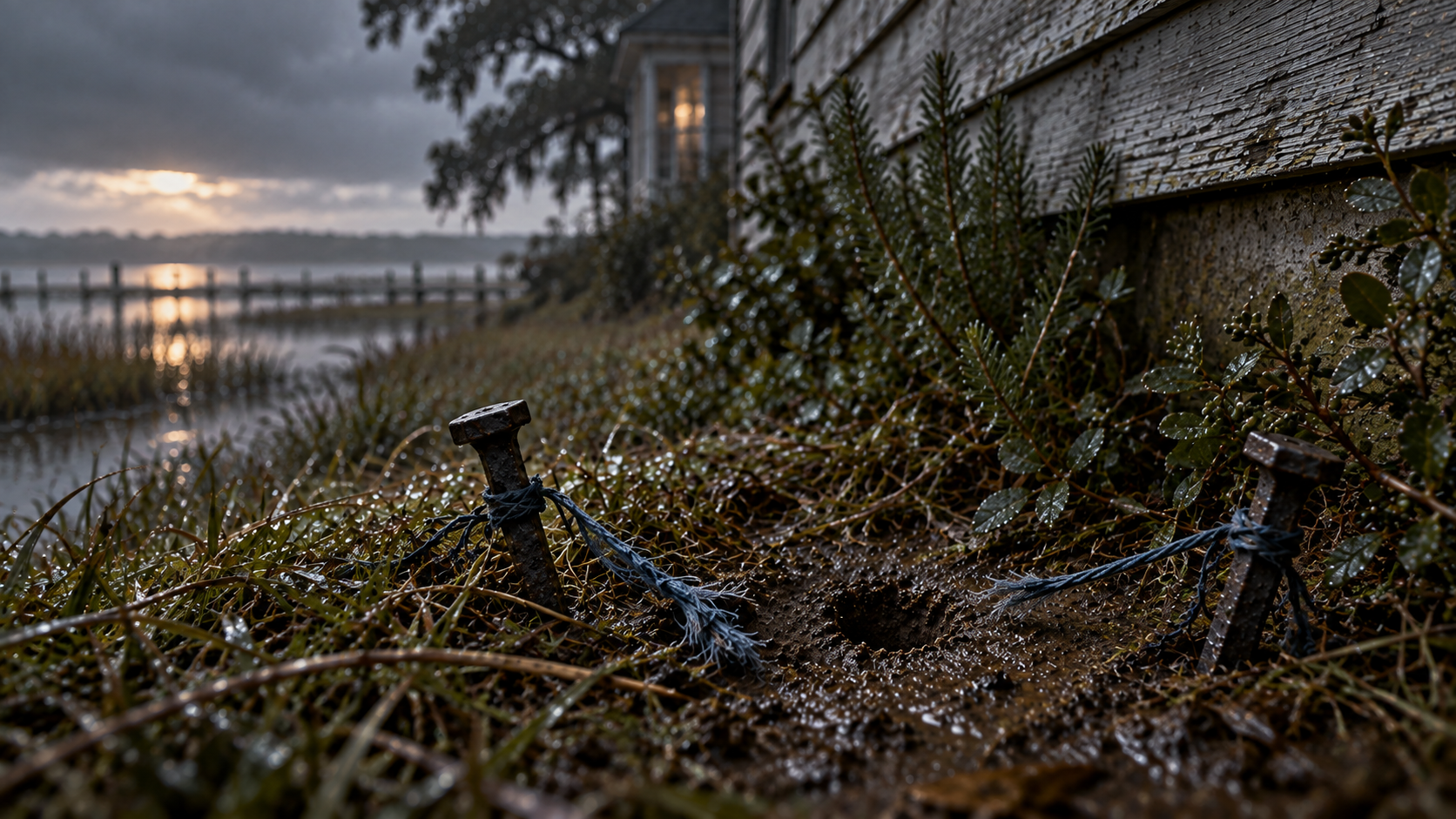
They checked the window latches from outside. They cleared leaves from a drain channel and lifted a fallen branch from the path. Along the eastern foundation, Clara found the three iron nails she had noticed when she arrived. Each one had been driven into the earth at a slight inward angle. Faded blue thread ran from one to the next, disappearing beneath rosemary and wax myrtle.
“What are they meant to keep out?” Clara asked.
“Wrong question.”
“You say that often.”
“You ask it often.”
Etta crouched beside the first nail and pressed two fingers to its head.
“A boundary is not defined only by what it refuses. It also states what it protects, what it permits, and who is responsible for tending it.”
“That sounds like a rule.”
“No. Rules tell the world what it must do. Boundaries tell the world what you will do.”
They continued around the northern side, where salt had silvered the cedar shingles. Clara saw the line of blue thread only when the light touched it. In some places it had been wrapped around roots. In others it passed through tiny holes drilled into the foundation boards.
At the western wall, Etta stopped.
Three shallow hollows marked the ground beneath the nearest window. Only two held nails.
The blue thread between them hung loose in the wet grass.
Clara stared at the empty hollow.
“The scrape,” she said.
“Perhaps.”
“You know it is connected.”
“I know a nail is missing and you heard a sound on this side of the house.”
Clara exhaled. “Observed.”
“Good.”
Etta knelt and studied the mud. There were no footprints, drag marks, or signs of an animal digging. The nail had not worked itself loose. Its narrow hole remained clean and sharply defined, as if someone had pulled it straight upward.
The severed end of the blue thread lay several feet away.
Clara reached for it.
“Gloves,” Etta said.
“Because it is magical?”
“Because it is wet cord lying in mud beside an old foundation. We can consider magic after tetanus.”
Clara pulled on the work gloves. She lifted the cord and found that it had not been cut. The fibers were stretched and ragged, torn by force.
The western wall gave a low wooden groan.
Both women looked up.
Behind the nearest window was the sitting room. The jar stood on the mantel, too far away to see clearly.
Something struck the glass from inside.
Once.
Etta rose.
“We repair this before the tide turns.”
“With one of your nails?”
“With one of Miriam's. Mine are in case hers are gone.”
They found a tin box in the shed beneath coils of rope and rusted pruning shears. Inside were nine square nails, each cleaned and rubbed with dark wax. A paper label had been fixed to the lid.
Not sacred. Necessary.
Clara smiled despite herself.
“That sounds like Miriam.”
“It does.”
Etta gave her the box, the hammer, and a length of blue cord.
“You are doing it.”
“I do not know how.”
“You know how to drive a nail.”
“I mean the rest.”
Etta looked toward the house. “What are you protecting?”
Clara nearly said the house. The answer felt obvious until she tried to speak it.
The house had belonged to a dead woman who had allowed Clara to mourn her for thirty-one years. It contained a red door that behaved like a mouth, a ring that carried her mother's voice, and something that laughed with a child's lungs. Clara did not know whether the house deserved protection from what was outside or whether the world needed protection from the house.
“The right to choose what enters,” she said at last.
“And what are you permitting?”
“Questions. Memory. People I invite.”
“And what are you refusing?”
Clara thought of Ruth telling her what she remembered incorrectly. She thought of the repeated question marks on her phone, each one asking her to account for herself without offering anything in return. She thought of the little voice using her name in the dark.
“Nothing gets to command me merely because it knows me.”
Etta nodded toward the empty place in the ground. “Then put that there.”
Clara wrapped the blue cord around the nail three times. She did not chant. She did not ask permission from the sky or the sea. She held the meaning clearly and drove the iron into the old hole.
The first strike rang too sharply. The second sank the nail halfway. On the third, the house shuddered from foundation to roof.
The sound from the jar stopped.
Clara tied the new cord to the old line and pulled it taut.
“Is that enough?” she asked.
“For this morning.”
“That is not comforting.”
“It is honest. Nothing cared for stays finished.”
They walked the boundary again. This time Clara noticed the things Etta had not pointed out: a split in the blue cord beneath the porch, a window latch beginning to rust, rosemary crowding an air vent, a place where rainwater collected against the foundation. None was dramatic. Together they described exactly how the house had been kept standing.
Her phone vibrated in her pocket.
Nine messages waited from Michael. The first asked where she was. The others were question marks.
Clara stared at them.
“Trouble?” Etta asked.
“Repetition.”
She called him.
Michael answered before the first ring completed.
“Where are you?”
“At a house in Morrow Point. My aunt left it to me.”
“What aunt?”
“The one my mother told me was dead.”
Silence.
“Clara, come home.”
The word home landed strangely. She looked at the gray house, the tightened blue cord, and the wet earth around her boots.
“I will call you Sunday.”
“Send me the address.”
“No.”
“Why not?”
“Because I am asking you not to come.”
He began to argue. Clara ended the call before he finished.
Her heart pounded as if she had done something dangerous. Perhaps, in the life she had been living, she had.
Etta pretended to be interested in the western gutter.
“You can stop pretending you did not hear that,” Clara said.
“I heard you tend your boundary.”
“It felt rude.”
“New boundaries often feel rude to people trained to disappear inside politeness.”
The marsh wind shifted. Beneath the smell of rain came the stronger scent of saltwater.
Etta checked her watch.
“The tide turns this afternoon. We have work to do before dark.”
“What kind of work?”
“Shutters. Sandbags. Lamps. Drinking water. Everything people forget while staring at a mysterious door.”
Clara started toward the shed, then remembered the dry socks and raincoat she had left in the car.
“I need my bag.”
Her car stood beneath the live oaks exactly where she had parked it. The doors were locked. The windows were closed. Beads of rain covered the windshield, and a few wet leaves clung to the roof.
Clara reached into her pocket for the keys.
Then she looked through the passenger window.
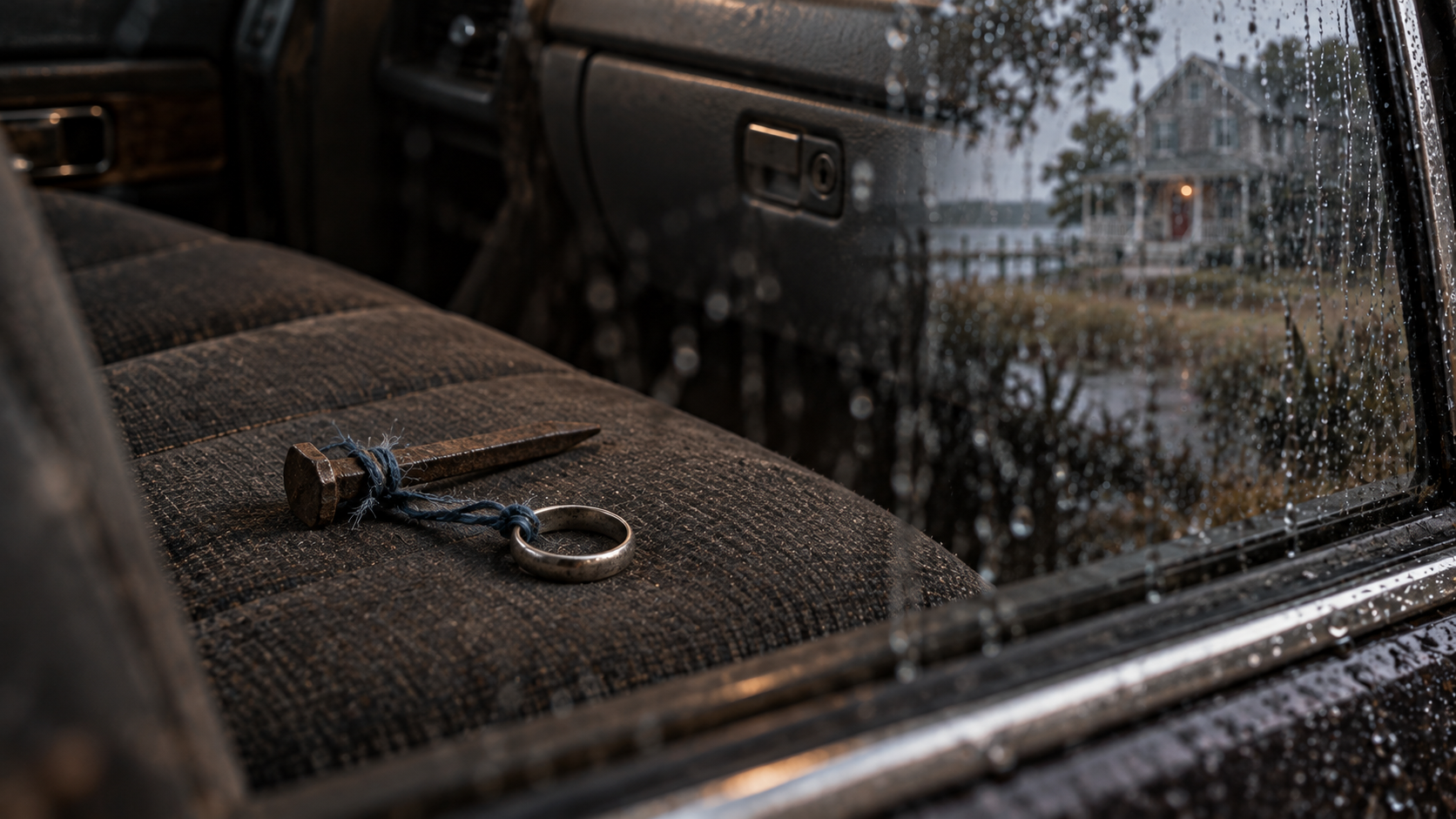
An old square nail lay on the seat.
Mud darkened its point. A length of faded blue thread had been tied around its head.
The other end passed through Clara's wedding ring.
The ring she had locked inside the glove compartment before she entered the house.
From the Keeper's Book: Protection Is a Practice
A ward is not a substitute for a lock, a repair, a difficult conversation, or a clearly spoken boundary. Protection becomes stronger when spiritual intention and practical care support one another.
Walk the boundary of the place you want to protect. Check the doors, windows, steps, locks, lighting, roofline, drains, and anything else that keeps the space sound. Notice what needs repair before adding herbs, salt, iron, bells, or cord.
Then name three things:
What am I protecting?
What do I welcome?
What do I refuse?
Choose one simple marker for that intention and tend it regularly. The power is not in performing one perfect act. It is in returning with attention before fear is required to remind you.
A ward is not a substitute for a lock, a repair, a difficult conversation, or a clearly spoken boundary. Protection becomes stronger when spiritual intention and practical care support one another. Walk the boundary of the place you want to protect. Check the doors, windows, steps, locks, lighting, roofline, drains, and anything else that keeps the space sound. Notice what needs repair before adding herbs, salt, iron, bells, or cord. Then name three things: What am I protecting? What do I welcome? What do I refuse? Choose one simple marker for that intention and tend it regularly. The power is not in performing one perfect act. It is in returning with attention before fear is required to remind you.
